
MyFitnessPal Alternatives: 4 Apps Compared (2026)
Four alternatives to MyFitnessPal—Fuel8, Lose It!, MyNetDiary, and Cronometer—compared on food database size, logging efficiency, privacy, offline capability, and tracking philosophy.
Fuel8 Editorial
15 October 2026
Updated 15 October 2026

Several alternatives to MyFitnessPal exist, each with different strengths in food logging speed, privacy, workout integration, and approach to motivation. People seek alternatives for reasons ranging from privacy concerns and subscription costs to the desire for offline functionality or a less gamified experience. This guide compares four alternatives using six consistent criteria: food database size and quality, logging efficiency, privacy handling, workout and progress tracking, offline capability, and philosophical approach to motivation.
Quick answer: Privacy-first and offline alternatives to MyFitnessPal
MyFitnessPal's cloud-first architecture and account requirement suit many users. Others prioritize on-device data storage, offline logging, or a tracking approach that avoids streaks and achievement scores.
Fuel8, Lose It!, MyNetDiary, and Cronometer each address different gaps. Fuel8 emphasizes privacy and local storage. Lose It! focuses on simplicity and calorie-centric logging. MyNetDiary balances features with privacy options. Cronometer targets micronutrient and athletic tracking.
Why users consider alternatives to MyFitnessPal
MyFitnessPal remains a large-database, widely-integrated tracker with broad workout support. But not everyone needs what it offers, and some actively avoid parts of it.
Privacy and data control. MyFitnessPal stores data on servers by default. Users concerned about third-party data access or data retention may prefer on-device logging.
Offline logging. Some alternatives allow food and workout logging without an active internet connection, which matters for people who travel, work in areas with poor coverage, or simply don't want their tracking tied to connectivity.
Subscription model. MyFitnessPal's premium tier gates features like barcode scanning and goal customization on some platforms. Users seeking equivalent features without recurring payments investigate other options.
Motivation philosophy. Streaks, achievement scores, and red-alert states discourage some people rather than motivate them. A less gamified approach to tracking appeals to those who just want the data.
Specific tracking goals. Users focusing on micronutrients, athletic performance, or macro precision may prioritize apps built around those specific aims rather than calorie-first designs.
How the alternatives were selected
This comparison began by identifying the core decision: which feature gaps or philosophies drive someone away from MyFitnessPal? Four alternatives emerged as genuinely distinct responses.
Fuel8 emphasizes privacy, offline logging, and a non-punitive tracking design. Lose It! simplifies calorie tracking with a smaller, curated food database and free base tier. MyNetDiary offers privacy controls and local syncing options alongside a large food database. Cronometer prioritizes micronutrient precision and athlete-focused metrics.
Each alternative was then evaluated against six material criteria that affect daily usability and alignment with user values.
Decision criteria: Six factors that matter
Food database size and provenance. A larger database reduces manual entry, but size alone doesn't guarantee accuracy. Data source and nutrition label currency affect reliability. A 1-million-item database with unverified entries may be less useful than a 500,000-item curated one.
Logging speed and method. Options include barcode scanning, voice input, photo estimation, and manual search. Fewer taps reduce friction. Ambiguous results don't.
Privacy model. Whether data lives on-device, syncs to user-controlled accounts, or connects to company servers affects how much personal health information leaves the phone, who can access it, and whether you can track without an account.
Offline capability. Core logging functions, food search, barcode lookup, and voice entry either work without internet or they don't.
Workout and progress tracking. Features range from basic exercise logging to detailed sets, reps, and weight tracking. Progress visualization may show weight trends, daily comparisons, or performance metrics.
Tracking philosophy. Some apps emphasize gamification, streaks, and achievement. Others prioritize consistency without shame or penalty for missed days. That philosophical difference matters more to daily experience than feature count.
Alternatives at a glance
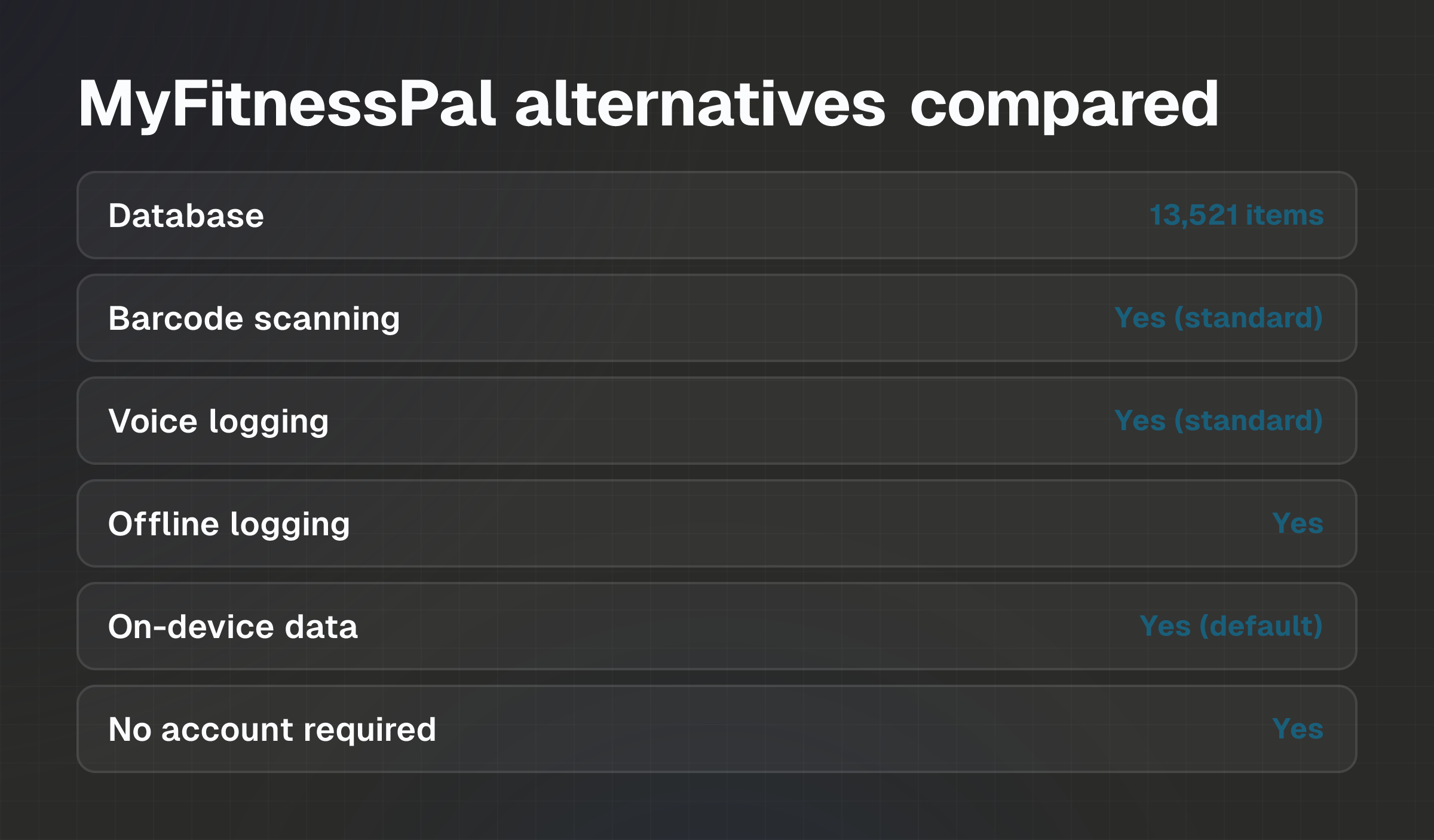
| Feature | Fuel8 | Lose It! | MyNetDiary | Cronometer |
|---|---|---|---|---|
| Database | 13,521 items | ~500k (curated) | ~600k items | ~650k items |
| Barcode scanning | Yes (standard) | Yes (free tier) | Yes (free tier) | Yes (free tier) |
| Voice logging | Yes (standard) | No | No | No |
| Offline logging | Yes | No | No | No |
| On-device data | Yes (default) | No | Optional local sync | No |
| No account required | Yes | No | No | No |
| Streaks/scores | None | Yes | Yes | Limited |
| Macro targets (grams) | Standard | Free tier | Premium only | Standard |
| Base price | Open launch (pricing planned at US$3/month) | Free (Premium ~US$9.99/month, regional pricing varies) | Free (Premium ~US$5.99/month, varies by region) | Free (Premium ~US$8.99/month, varies by region) |
The best alternatives
Fuel8: Privacy and offline-first tracking
Fuel8 allows food and workout logging without creating an account. The app stores all data locally on the phone by default. No data leaves the device unless the user explicitly enables features like account sync, coach access, or barcode updates. The food database contains 13,521 items. Voice logging, barcode scanning, and macro targets in grams are included as standard, not gated behind a subscription.
Meaningful advantage: Full offline capability and local-only data storage appeal to users who prioritize privacy and connectivity independence. You can log in a parking lot, on a plane, or in a basement gym without wondering if your data reached the cloud.
Meaningful limitation: The database is smaller than MyFitnessPal's or Cronometer's, which may require more manual entry for some foods, especially prepared restaurant items and regional specialties.
Lose It!: Simplified, curated logging
Lose It! uses a smaller, curated database of approximately 500,000 items and emphasizes calorie-centric tracking over macro precision. The free tier includes barcode scanning and basic goal-setting. A Premium subscription unlocks additional recipe features and profile customization.
Meaningful advantage: The curated database reduces ambiguous duplicate entries and simplifies logging for users prioritizing speed over micronutrient detail. Less clutter means fewer decisions per meal.
Meaningful limitation: The free tier doesn't include calorie goals set by the app, so users must set their own targets. All data syncs to Lose It!'s cloud servers; no local-only option exists.
MyNetDiary: Balanced features with privacy controls
MyNetDiary offers a large food database (~600,000 items), barcode scanning on the free tier, and optional local syncing via a user account. The app includes detailed workout and progress tracking, including weight trend visualization.
Meaningful advantage: The optional local-sync feature gives users choice over whether data syncs to servers, addressing a middle ground between full cloud dependency and total offline operation.
Meaningful limitation: Setting up local-only sync requires an account, which contradicts the "no account" appeal that some alternatives offer. Macro targets in grams require a Premium subscription.
Cronometer: Micronutrient and athlete focus
Cronometer prioritizes tracking vitamins, minerals, and other micronutrients alongside macros and calories. The app includes performance metrics useful for endurance and strength athletes, such as sodium intake for endurance events and iron for cyclists. The food database contains approximately 650,000 items.
Meaningful advantage: Micronutrient tracking and athlete-specific metrics serve users with detailed nutritional goals beyond basic calorie and macro balance. If you need to know your B12 intake or potassium levels, Cronometer delivers.
Meaningful limitation: The interface and feature depth can feel overwhelming for casual trackers. Micronutrient data relies on USDA and other public databases, which vary in completeness by food category. All data syncs to Cronometer's cloud servers; no permanent on-device-only mode exists.
Where Fuel8 may fit
Fuel8 suits users who prioritize privacy, want to log offline, and prefer a tracking approach without streaks or shame states. It works best for people comfortable with a smaller database, which requires occasional manual entry or descriptive logging, and those who don't need detailed athletic metrics or micronutrient tracking. The absence of an account requirement appeals to users skeptical of repeated account creation or those with privacy concerns about account linkage to other services.
Fuel8 is less suitable for users who rely on seamless cloud sync across devices, who need a very large pre-filled database to minimize manual work, or who want extensive micronutrient or athletic performance data.
Important limitations and trade-offs
Accuracy versus logging effort
Photographic food estimation carries substantial error. Research shows photographic estimates can be 17% off, and AI models for food recognition show mean absolute percentage errors of approximately 36% for energy content.
Hand-weighed portions logged manually remain the most accurate method. They also require more effort than photo-based shortcuts. That trade-off is real. I photographed my breakfast, then weighed it. shows the gap between photo estimates and scale measurements.
Daily weight fluctuations versus trends
Weight rises predictably on weekends and falls during working weeks due to activity and meal patterns, not necessarily fat gain or loss. Orsama and colleagues analyzed 4,657 daily weigh-ins and concluded that "weight variations between weekends and weekdays should be considered as normal instead of signs of weight gain." Apps that emphasize daily weight as a success metric risk demoralizing users. Weigh daily. Believe the weekly average. explains why trend-based views matter more than daily comparisons.
Exercise calorie estimates and net versus gross
Most apps report gross calories burned during exercise, which includes resting metabolism. Net calories, added energy expenditure only, are roughly half the gross figure. The 2024 Adult Compendium of Physical Activities provides gross figures; converting to net requires subtracting resting metabolic cost, which varies by body composition and activity intensity. Overestimating exercise calories creates an unintended caloric surplus. Calories eaten versus calories burnt breaks down this trade-off in detail.
Pricing and feature availability
Exact pricing varies by region, app store platform, and subscription plan. Figures below are current as of the research date but subject to change.
Fuel8: Currently in open launch. Fuel8 states that pricing for Founders Entry is planned at US$3 per month, though the exact availability and pricing may change. All logging features are included during the launch period.
Lose It!: Free base tier includes barcode scanning and basic logging. Premium ~US$9.99/month (regional variation applies; web and App Store prices may differ).
MyNetDiary: Free base tier includes barcode scanning. Premium ~US$5.99/month (regional variation applies).
Cronometer: Free base tier includes full food tracking. Premium ~US$8.99/month (regional variation applies).
All regional, web, and App Store pricing may differ from stated figures. Verify current rates on each app's official pricing page before committing.
Privacy and connected features
Fuel8
Fuel8 supports local food, workout, and progress logging without an account. All data is stored on-device by default. Connected features, such as account sync, Apple Health export, coach access, or barcode database updates, require explicit user action to enable. New barcode lookups and progress-photo uploads are the only functions that contact Fuel8's servers; all other data remains on the phone. Fuel8 uses local word matching and has no AI features or server-side speech recognition.
Lose It!
All logged data syncs to Lose It!'s cloud servers by default. The app doesn't offer a local-only mode. Data is tied to a user account.
MyNetDiary
Data syncs to MyNetDiary's servers by default, but the app offers optional local syncing via account settings. A user account is required to enable local sync.
Cronometer
All logged data syncs to Cronometer's cloud servers by default. No local-only mode exists. Data is tied to a user account.
Which alternative fits which priorities
Privacy-first, offline logging: Fuel8 (no account, local-only default, full offline capability).
Speed and simplicity: Lose It! (curated database, free tier with barcode scanning, streamlined interface).
Flexibility with privacy controls: MyNetDiary (optional local sync, large database, balanced feature set).
Micronutrient and athletic detail: Cronometer (comprehensive micronutrient tracking, athlete-focused metrics, large database).
No account, no commitment: Fuel8 (no signup required; all features available without account or subscription during open launch).
Evidence, disclosure and last verified
This comparison draws on verified facts from official product websites, help documentation, privacy policies, and current App Store listings. Pricing figures are subject to regional and platform variation; verify on the respective app's official pricing page. Database sizes are sourced from official product pages or documentation and reflect figures stated by each firm.
Photographic food estimation error: Fridolfsson et al. and a second study found mean absolute percentage errors of approximately 36% for energy across 1,463 US meal photographs.
Restaurant calorie underestimation: Studies show average estimates out by 175 calories, with error increasing as meal size grows. Research shows meals perceived as healthy are underestimated by 20% in adults and 25% in adolescents.
Weight fluctuation research: Orsama et al. analyzed 4,657 daily weigh-ins and found consistent weekend-weekday variation.
Exercise calorie estimates: Mookerjee, Welikonich, and Ratamess measured gross versus net calories for a weights session, finding net calories to be roughly half of gross.
Last verified: October 14, 2026
Disclosure: This alternatives guide is published by Fuel8.
FAQs
Does a smaller food database make an app less accurate overall?
No. Database size, data provenance, item completeness, and nutrition accuracy are separate criteria. A curated 500,000-item database with verified USDA data may produce more accurate logs than a 1-million-item database with duplicates and unverified user entries. Smaller databases often require more manual entry but reduce ambiguous matches.
Can I export my data if I switch apps?
Export capability varies. Most mainstream trackers support CSV or JSON export from account settings or support requests. Fuel8 stores all data locally and doesn't impose export restrictions. Check the specific app's help documentation for supported formats and timelines.
Will an app that doesn't use AI give me less accurate food recognition?
AI-powered barcode matching and image recognition can speed logging, but accuracy depends on database quality and the AI model's training data. Local word matching (used by Fuel8) is less speedy but often more predictable because it returns only exact or partial name matches rather than probabilistic guesses. Neither approach guarantees accuracy; hand-weighed portions remain the reference standard.
Is logging to a past day useful?
Yes. Life happens unevenly. Someone may not log a meal until hours later or may realize they forgot to log breakfast. Apps that prevent logging to previous days force users to choose between inaccurate same-day estimates or skipping the entry entirely. Logging to a past day preserves accuracy even when logging speed is delayed.
Do I need a Premium subscription to track macros?
Not with all apps. Fuel8, Cronometer, and Lose It! all include macro tracking on the free tier. MyNetDiary requires Premium for macro targets set in grams, though the free tier shows macro percentages. Verify current feature availability on each app's official page.
What's the difference between net and gross exercise calories?
Gross calories burned include your resting metabolism during the activity. Net calories represent only the added energy expenditure above what you would burn at rest. Net is typically 40-50% of the gross figure. Apps that report gross only may overestimate how much exercise "earns" extra food, leading to unintended caloric surplus.
- App Alternatives
- MyFitnessPal alternatives
- food tracking apps
- offline food logging
- privacy-focused nutrition app
Fuel8 is on the App Store.
A food diary for iPhone. It tracks protein, carbs and fat alongside calories, shows a weight trend rather than a daily verdict, never adds exercise calories back, and has no streaks to break.
Download on the App StoreGet the seven-day Fuel8 email guide, including how the app works and membership benefits. Then occasional recipes and product updates.
Your name and email go to Grow More Services L.L.C-FZ, the company that builds Fuel8, and are stored in Resend so we can email you the seven-day app guide, membership benefits, recipes and product updates. An account is not required. Unsubscribe in one click, any time.
This piece is editorial content and not medical or dietary advice. The full health disclaimer is below.