
How Calorie Trackers Estimate Food Energy: The Science
Calorie estimates in food-logging apps come from laboratory analyses of representative food samples, compiled into searchable databases. Understanding the gap between estimate and reality helps you set realistic expectations for what tracking can deliver.
Fuel8 Editorial
22 October 2026
Updated 22 October 2026
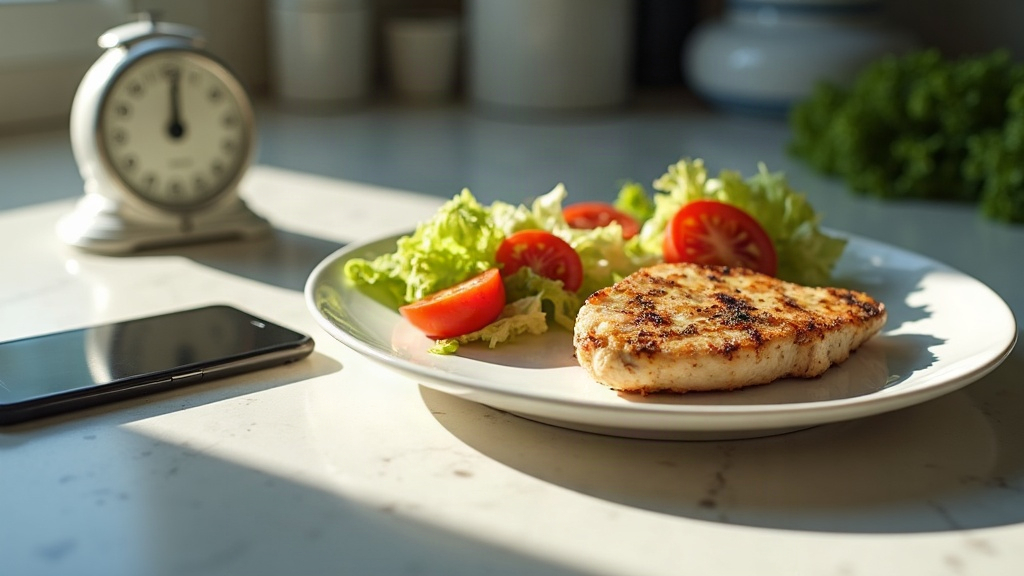
Calorie estimates in food-logging apps come from laboratory analyses of representative food samples, compiled into searchable databases. When you log a meal, the app multiplies the database calorie value by your entered portion size. That calculation rests on two inputs: the database entry, which represents an average rather than your specific food, and your portion estimate, which research shows is often wrong by 100+ calories. Understanding this gap between estimate and reality helps you set realistic expectations for what tracking can deliver.
Key takeaways: Where calorie counts originate and what they actually represent
Calorie databases are constructed from lab measurements of representative food samples, rather than your specific apple or chicken breast. Estimating portion sizes is a significant source of logging error, as restaurant meals often contain more calories than anticipated. Variations in preparation methods, brand differences, and cooking techniques can lead to discrepancies between the calories consumed and the app's estimates. Logging your food intake, even if done roughly, is more beneficial than not logging at all; consistency is more important than striving for perfect accuracy.
What it means: The source and limits of app-based calorie estimates
When you search for "chicken breast" or scan a barcode in a food tracker, you're accessing a food database. These databases contain calorie and macronutrient data derived from laboratory analysis, typically done using established methods like bomb calorimetry, which measures total energy, and Atwater factors, a system that estimates calories from protein, fat, and carbohydrate content.
A database entry doesn't represent every chicken breast. It represents an average from a sample of chicken breasts tested under controlled conditions.
The actual chicken on your plate may have been raised differently, stored differently, or cooked with different amounts of oil. All of these change its calorie content. The same principle applies to produce, packaged goods, and restaurant meals. When you log "1 medium apple" (roughly 185 calories in most databases), that number is a reference point, not a measurement of the apple you ate.
Why it matters: Precision versus consistency in fitness tracking
Fitness goals depend on calorie intake over days and weeks, not on any single meal being exactly right.
But systematic errors accumulate. If you consistently underestimate portions or miss preparation methods, those gaps compound and affect whether you hit your targets.
Research indicates that individuals often underestimate the calorie content of meals they consider healthy. This creates a particular trap: the meals where you think accuracy matters least, like salads or grilled fish, are often the ones you're most mistaken about. In restaurant settings, the discrepancy becomes even more pronounced. When researchers measured actual restaurant meals using calorimetry, estimates were off by an average of 175 calories. More concerning, the error increased with larger meals, suggesting that the meals where accuracy is most critical are precisely those people misjudge the most.
Understanding that these gaps exist helps you choose a logging approach that fits your tolerance for uncertainty and your goal. If you need a rough sense of intake to stay consistent, simpler methods work. If you're targeting a specific calorie or macro range, you need measurement tools, a scale, and database accuracy you can verify.
How it works: From database to your daily log
Finding the food
You enter a food by searching a database, scanning a barcode, using voice input, or entering it manually. Most trackers, including Fuel8, store a local database on your phone, Fuel8 includes 13,521 offline food entries, so lookups work without an internet connection.
For packaged goods, barcode scanning links you to the product's stated nutritional information, which often comes directly from manufacturer labels. For fresh foods and recipes, the app matches your description to a database entry and shows you the calorie and macronutrient values for a standard unit: 100 grams, 1 medium, 1 cup, 1 serving.
Entering your portion
You select the unit that matches how you measured or estimated the food, then enter the quantity.
This is where the largest source of error enters the picture. Visual estimation, guessing portion size by eye, is notoriously inaccurate. A "handful" of nuts or a "medium" piece of fish varies wildly depending on hand size, how tightly you pack it, and the actual dimensions of the food. Weighing eliminates this error almost entirely, but requires a scale and the discipline to use it consistently.
Calculating your total
The app multiplies the database values by your portion quantity and adds the result to your daily total. For recipes, it sums the entries for each ingredient. For your day, it sums all logged meals.
Example or scenario: A single breakfast, three estimates
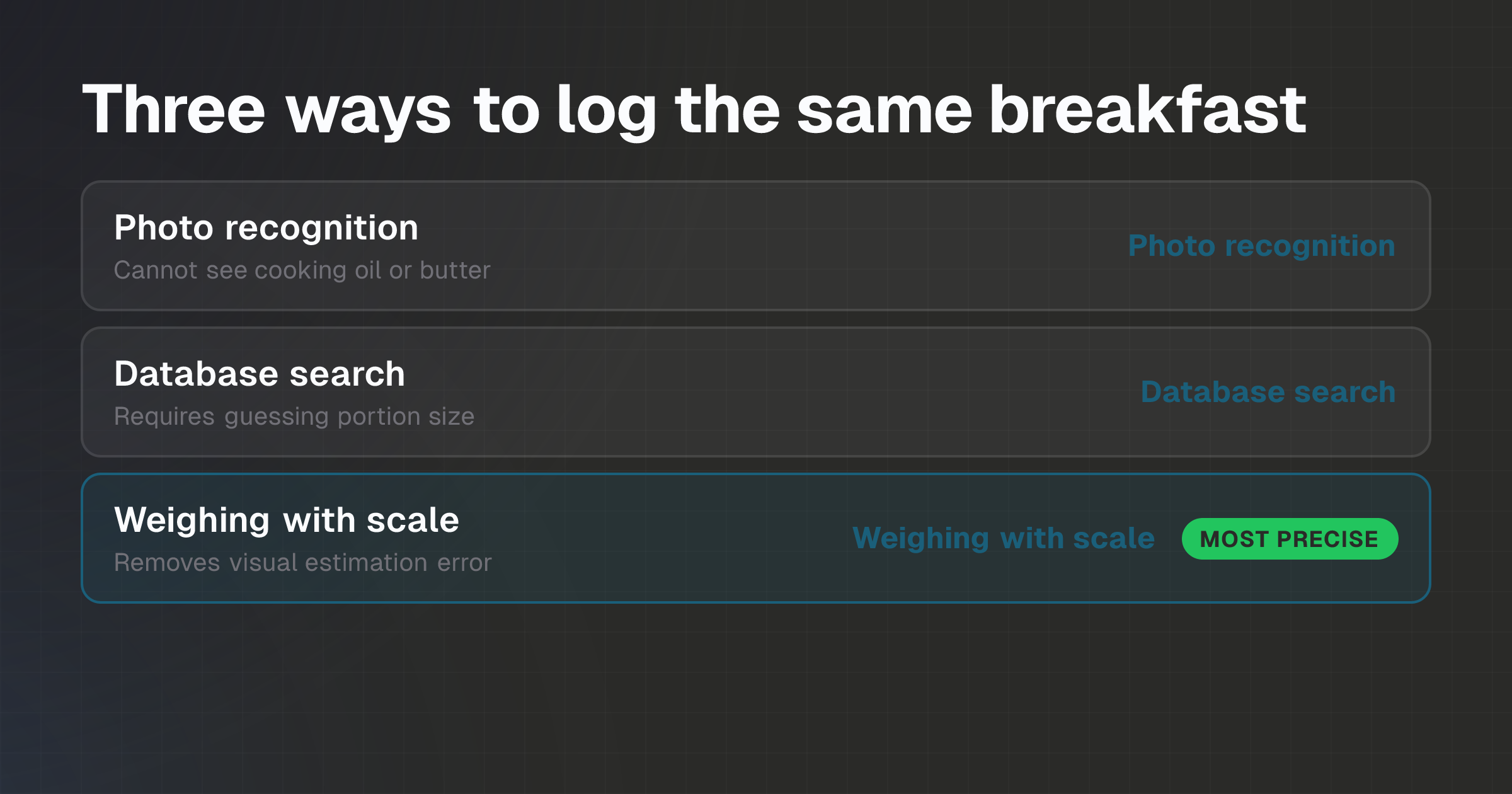
To see how this works in practice, consider logging a breakfast of two scrambled eggs, a slice of toast, and a cup of coffee with milk.
Using a photo: If you photograph the plate and use an app's photo-recognition feature to estimate calories, you might get 420 calories. The app identifies eggs, bread, and a beverage, but cannot see whether the eggs were cooked in butter, oil, or dry, a difference of 80-120 calories.
Using a database search: If you search "scrambled eggs, 2 large" you might find 180 calories, add "1 slice toast" at 80 calories, and "1 cup coffee with milk" at 35 calories, for a total of 295 calories. But that scrambled eggs entry assumes a standard cooking method and portion size that may not match yours.
Using a scale: If you weigh the cooked eggs (180g), toast (30g), and measure the milk (240ml), you can cross-reference your tracker's database entries to the actual weights you used. You might log 340 calories.
This is still an estimate, the database doesn't know the brand of butter or the exact recipe, but it's anchored to real measurements. The photo method is fastest but least precise. The database search is faster than weighing but requires guessing portion size. Weighing is slowest but removes the largest source of error: your visual estimate.
Your choice depends on your goal and your tolerance for uncertainty. A day logged roughly is worth more than a day not logged at all, but if you're trying to hit a specific calorie target, the logging method matters.
Common mistakes or risks: Where tracking breaks down
Underestimating portion size
Visual estimation is the single largest source of calorie-logging error.
You might think you're eating one portion; the actual portion is 1.5× what you estimated. Over a week, this creates a cumulative gap between your recorded intake and your actual intake.
Overlooking preparation and cooking methods
"Grilled chicken" and "fried chicken" look similar in a database but differ by hundreds of calories. The same goes for vegetables cooked in oil, sauces added to meals, and side dishes. If you search for "chicken breast" without specifying the cooking method, you might select an entry for plain roasted chicken when you actually ate chicken sautéed in butter and garlic.
Mismatched healthy-food bias
Research shows you're most likely to underestimate calories in meals you perceive as healthy. A restaurant salad with dressing, nuts, and cheese might contain 600+ calories, but because you categorize it as a "healthy choice," you estimate it at 400.
This isn't a character flaw, it's a documented cognitive bias. Countering it requires either weighing suspicious meals or accepting that your logging for those meals carries larger error.
Brand and product variation
A nutrition label on a packaged good is legally required to be accurate, but a generic database entry for "yogurt" or "cereal" is an average across many brands and formulations. If your specific yogurt or cereal differs from the database average, your logged calories will be off.
Restaurant meal discrepancies
Restaurants aren't required to measure their food precisely, and stated calorie counts are sometimes inaccurate. Research has found that 19% of restaurant meals contained at least 100 calories more than stated. This isn't something you can fix in the app, it's a limitation of the data source itself.
Logging fatigue
Over time, logging often becomes less detailed. You move from weighing portions to estimating, skip logging side dishes, or stop tracking altogether. A day logged badly is worth more than a day not logged at all, but weeks of increasingly loose logging accumulate error.
How to choose or what to do next: Matching method to goal
Your logging method should fit your goal and your willingness to measure.
If your goal is a rough sense of daily intake: Use a food tracker's search database and estimate portions visually. Accept that your daily total is probably within ±300 calories of reality. Log consistently, and trust the weekly average rather than any single day.
If your goal is to hit a specific calorie target: Use a food scale for meals you cook. For packaged foods, use barcode scanning. For restaurant meals, research the stated calorie count beforehand and add 10-15% to account for typical underestimation. Log the cooking method, oil, butter, sauce, explicitly in the app so you select the correct database entry.
If you're uncertain whether a meal estimate is reasonable: Enter what you think, then note it as an estimate in your log. Record the actual ingredients and portions the next time you make it. Cross-check your estimate against the measured version.
If you switch logging methods: Don't expect your estimates to stay constant. A meal logged by photo will estimate differently from the same meal logged by weight.
Accept this variance as part of the process, not a sign that one method is "right" and the others are "wrong." The most useful tracker is the one you'll actually use. A day logged badly is worth more than a day not logged at all. Consistency over precision is the operating principle that works in real life.
FAQs
What does "Atwater factors" mean, and why should I care?
Atwater factors are numbers used to estimate calories from the amount of protein, fat, and carbohydrate in a food: 4 calories per gram for protein and carbohydrates, 9 per gram for fat. Most food databases use these as a starting point. They're useful because they let trackers estimate calories for foods that haven't been lab-tested, but they're averages, not exact for every food or body. Understanding they're estimates helps you accept that your app's calorie figure is a reference point, not a measurement.
Why does a "medium apple" have different calorie counts in different apps?
Because different databases use different reference samples. One app's "medium apple" might be based on apples averaging 182g; another's on apples averaging 165g. Both are correct for their database. This is why weighing matters if precision matters to you. If you're estimating by portion, one apple, accept the variance across apps and pick one to stay consistent.
Can I trust the calorie count on a restaurant's website or menu?
Not entirely. Research shows that 19% of restaurant meals contained at least 100 calories more than stated. Restaurants estimate calories, they don't usually measure them. Use stated counts as a starting point, but add 10-15% and log conservatively if you're tracking to a tight calorie target.
What's the difference between weighing food and using a food scale app?
A food scale, the kitchen tool, measures actual weight in grams or ounces. A food scale app estimates portion size from a photo. The physical scale is far more accurate. Use it if precision matters to your goal.
Should I log foods that I can't measure accurately?
Yes. Log them as an estimate. A day logged badly is worth more than a day not logged at all. Use future instances of the same meal, or a similar one, to refine your estimate. Over time, rough logging becomes more consistent.
Why do I underestimate healthy meals more than indulgent ones?
Research shows this is a documented cognitive bias: people perceive meals labeled as healthy as having fewer calories than equally caloric indulgent meals. It's not about willpower or attention, it's about perception. Counter it by weighing suspicious meals or accepting that your logging for health-focused restaurants carries larger error and adjusting your targets accordingly.
Last verified: October 22, 2026
- Calorie & Macro Fundamentals
- calorie tracker accuracy
- food database calories
- portion size estimation
- calorie counting errors
Fuel8 is on the App Store.
A food diary for iPhone. It tracks protein, carbs and fat alongside calories, shows a weight trend rather than a daily verdict, never adds exercise calories back, and has no streaks to break.
Download on the App StoreGet the seven-day Fuel8 email guide, including how the app works and membership benefits. Then occasional recipes and product updates.
Your name and email go to Grow More Services L.L.C-FZ, the company that builds Fuel8, and are stored in Resend so we can email you the seven-day app guide, membership benefits, recipes and product updates. An account is not required. Unsubscribe in one click, any time.
This piece is editorial content and not medical or dietary advice. The full health disclaimer is below.