
Fuel8 vs Pen and Paper: Which Workout Log Fits You?
New exercisers often skip workout logs, making progressive overload nearly impossible. This guide compares integrated app tracking against pen-and-paper methods for logging strength and cardio workouts.
Fuel8 Editorial
19 October 2026
Updated 19 October 2026

New gym members and home exercisers usually log workouts inconsistently, or not at all. Whether tracking strength training (sets, reps, weight) or cardio (duration, intensity), spotty records make it nearly impossible to apply progressive overload, the gradual increase in challenge that actually drives fitness gains. This article compares Fuel8's integrated workout-and-nutrition logging against the simplest alternative: manual pen-and-paper tracking. Both work. The choice depends on whether you want data in one place with structured review, or offline simplicity with zero account friction.
Quick verdict: Local logging versus paper
Fuel8 pairs workout data with nutrition records in a single app, letting you review effort and fuel consumed side by side. Pen and paper requires no account, no device, no learning curve, but demands manual transcription to spot trends.
Neither method is inherently better. The trade-off is convenience and insight against friction and privacy.
At a glance
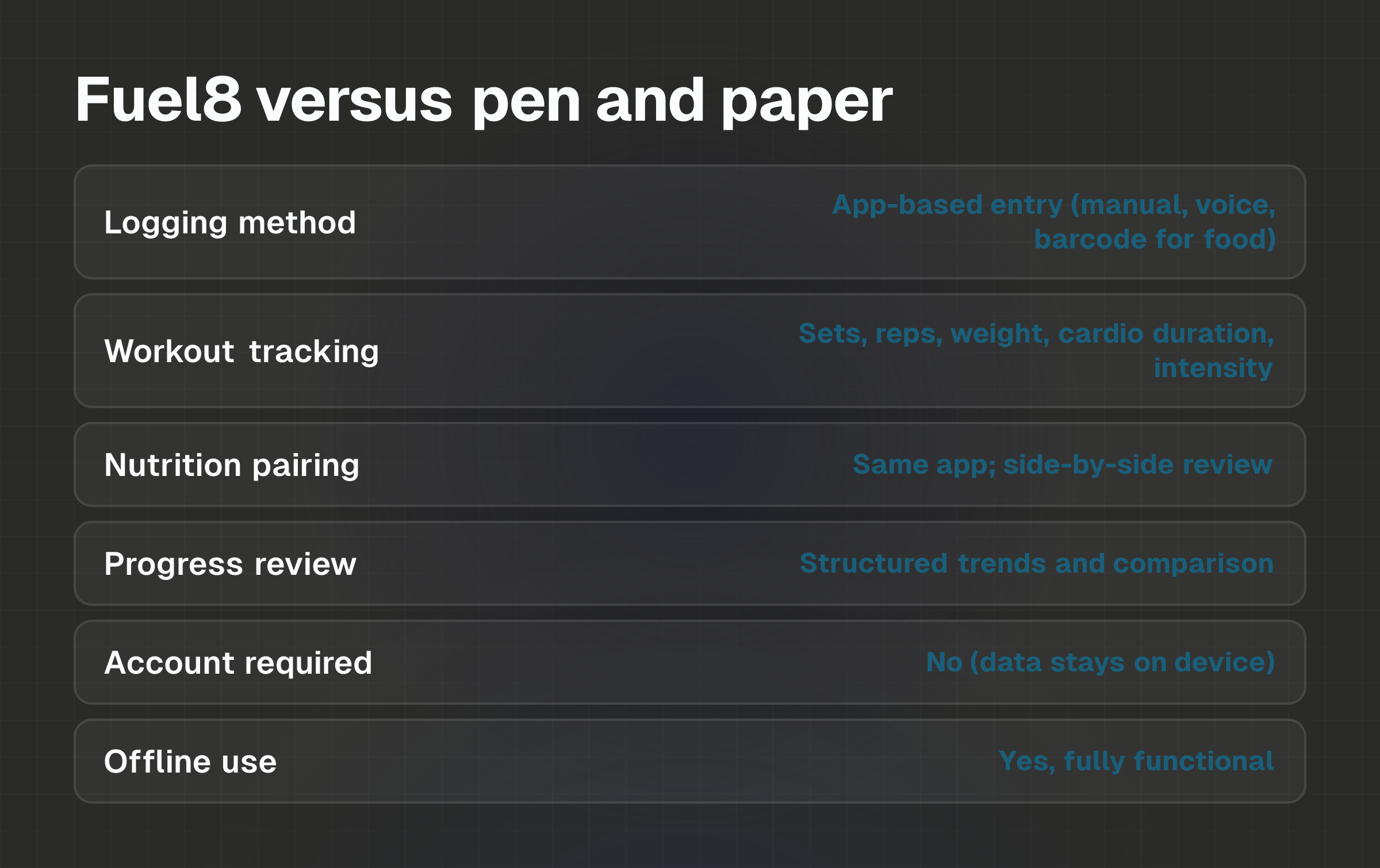
| Feature | Fuel8 | Pen and Paper |
|---|---|---|
| Logging method | App-based entry (manual, voice, barcode for food) | Handwritten notes |
| Workout tracking | Sets, reps, weight, cardio duration, intensity | Whatever you choose to record |
| Nutrition pairing | Same app; side-by-side review | Separate book or notebook |
| Progress review | Structured trends and comparison | Manual calculation and recall |
| Account required | No (data stays on device) | No |
| Offline use | Yes, fully functional | Yes, always |
| Syncing/sharing | Optional (with coach or cloud backup if enabled) | Not applicable |
| Cost | Free during current launch period; Founders Entry planned at US$3/month | Cost of notebook and pen |
| Platform | iPhone only | None (physical) |
How the comparison was made
This comparison draws on documented requirements for new exercisers: sets, reps, weight, duration, intensity, and the reasons consistent logging matters. Progressive overload requires a record. Trend identification requires comparable data points. Adherence improves when you can see what you've completed. Informed adjustment demands evidence, not memory.
Fuel8's approach is verified against its official app description and website. Pen and paper represents the baseline manual method, a control group rather than a competitor product.
Both are assessed against six decision criteria: data structure, offline function, account friction, workout-and-nutrition pairing, trend review capability, cost.
Food logging and nutrition data
Fuel8 logs meals and nutrition in the same app where workouts live.
The app includes a database of 13,521 foods, barcode scanning, voice input. Users search the database, scan a packaged item's barcode, or describe a meal aloud; macros (protein, carbohydrate, fat, calories) populate automatically.
Fuel8 stores all records on the device. Nothing leaves the phone unless the user enables cloud backup or shares data with a coach.
Pen and paper requires users to estimate or look up nutrition information outside, via a reference book, website, calculator, then write the totals in a separate log. Accuracy depends entirely on research effort and manual arithmetic. Integration between food and workout records is possible but requires deliberate side-by-side note-taking or transcription.
Research shows that meals perceived as healthy are underestimated by 20% in adults and 25% in adolescents compared to clearly indulgent ones of the same actual size. Studies show consistent underestimation of calories in restaurant meals, with error increasing as meal size grows; the average estimate misses by 175 calories.
Both logging methods depend on accurate input. App databases and pen-and-paper estimates are both subject to human error and assumption.
Workouts, progress and connected features
Fuel8 lets users log workouts (exercises, sets, reps, weight, volume, cardio duration and intensity) alongside meals, water intake, sleep, weight in one record. This integrated approach helps users and coaches review the full picture of effort and recovery in a single view.
The app stores all records locally. Syncing and sharing are optional, occur only when the user enables them.
Pen and paper requires maintaining a separate workout log from nutrition records. Users write exercises, weights, reps, duration by hand, then must manually cross-reference them with nutrition entries to spot patterns, for example, whether insufficient protein coincides with plateaued strength gains. Trends must be calculated or observed by eye over time.
Both methods enable the core practice: recording the minimum data points (sets, reps, weight for strength; duration and intensity for cardio) that allow progressive overload.
Consistent logging provides a record of past performance, enabling users to systematically increase weight, reps, or duration. Over time, logged data highlights patterns in performance, indicating when to push harder or scale back. The act of logging itself serves as a commitment device, reinforcing the habit of exercising. When progress stalls, the log offers data points to analyze and determine potential causes, allowing for targeted modifications to the training plan.
Fuel8 offers optional connection with coaches. When enabled, a coach can see the user's workout and nutrition records together, informing real-time feedback.
Pen and paper offers no built-in sharing or collaboration.
Offline use
Both Fuel8 and pen and paper work entirely offline.
Fuel8 functions without internet or an app account; all food and workout data remain on the device. Logging continues regardless of connectivity.
Pen and paper requires no connectivity at any stage.
Accounts and privacy controls
Fuel8 requires no account, password, or sign-up to use. All logged data, meals, workouts, water, sleep, weight, stays on the device. No personal information is collected or sent to Fuel8's servers by default.
Users may optionally enable cloud backup or share data with a coach, but this isn't automatic. Data shared with a coach is visible only to that coach and only in the context of the user's permission.
Pen and paper creates no account and generates no digital record unless the user manually transcribes it.
Neither method creates a privacy risk in the default state. The difference is that Fuel8 offers an optional pathway to share data (useful if working with a coach), whereas pen and paper remains entirely private by design.
Pricing and feature availability
Fuel8 is free during its current open-launch period.
Fuel8 states that Founders Entry pricing is planned at US$3 per month. Premium features, including barcode scanning, voice logging, macro targets in grams, logging to a past day, are currently included at no cost during the launch phase.
Pricing and feature availability may change.
Pen and paper incurs only the cost of a notebook and pen.
Limitations and trade-offs
Fuel8 limitations:
- iPhone only; no Android version.
- Requires data entry or barcode scan for each food item; automation is limited to barcode lookup.
- Depends on database accuracy; if a food item in the database is mislabeled, the user inherits that error.
- Optional features like coach sharing and cloud backup require deliberate setup; they don't occur automatically.
Pen and paper limitations:
- No automatic trending or calculations; users must manually identify patterns.
- Nutrition data requires external lookup; no integrated database.
- No structured prompts to ensure consistent data capture (sets, reps, weight).
- Difficult to share with a coach unless the user transcribes or photographs entries.
- No easy comparison across weeks or months without manual review.
Both methods depend on the user's commitment to log immediately or shortly after exercise. Accuracy decreases with delay.
Over-complication, tracking too many metrics, can lead to frustration and abandonment of logging. Focus on the minimum data points that matter: for strength, sets, reps, weight; for cardio, duration and intensity (heart rate, pace, perceived effort).
Which app fits which priorities
Choose Fuel8 if:
- You want to see workouts and nutrition side by side and spot patterns (e.g., whether low carbs coincide with weak lifting days).
- You plan to work with a coach and want to share structured data easily.
- You want automatic progression tracking without manual calculation.
- You use your phone for other fitness data (health apps, wearables) and prefer one central log.
- You value having a food database to reduce lookup time.
- You want to keep all records on your phone with no account or cloud exposure by default.
Choose pen and paper if:
- You prefer to avoid any app or account altogether.
- You work in an environment where a phone isn't practical (some gym settings, for example).
- You want to minimize data entry friction by writing only the few data points you care about most.
- You don't plan to share data with a coach.
- You value the tactile, intentional experience of handwriting logs.
- You don't need to identify complex trends across metrics.
Evidence, disclosures and last verified
This comparison is based on verified product features and published research on workout logging and progressive overload principles. Fuel8's features are verified against the app's official description and website as of the date listed below. Pen and paper represents the control baseline, not a commercial product. Research citations on calorie underestimation are drawn from peer-reviewed sources.
Last verified: October 19, 2026
FAQs
Why does consistent workout logging matter?
Consistent logging enables progressive overload, the gradual increase in weight, reps, or duration that drives adaptation.
Without a record of past performance, it's difficult to know whether you're challenging yourself enough or whether you've already done that weight-and-rep combination before.
Logging also serves as a commitment device: seeing a record of completed workouts can reinforce the habit of exercising.
What is the minimum data I need to track for strength training?
For strength training, record the exercise name, number of sets, number of reps per set, and the weight lifted.
This enables you to apply progressive overload: next session, try to add a rep, another set, or a small increase in weight.
Without these four data points, it's hard to ensure that workouts are challenging enough to drive adaptation.
What is the minimum data I need to track for cardio?
For cardio, record the activity type, total duration, and a measure of intensity, either heart rate, pace (miles or kilometers per hour), or a simple rating (easy, moderate, hard).
Intensity matters because two 30-minute runs aren't equal if one is a slow recovery pace and the other is at near-maximum effort.
Logging intensity helps you balance hard and easy days and avoid overtraining.
How quickly should I log a workout after I finish?
Log workouts immediately or as soon as possible after finishing.
Accuracy decreases significantly with delay. A few minutes later is fine; relying on memory days later introduces error and increases the chance of forgetting details.
Can I use both Fuel8 and pen and paper at the same time?
Yes. Some users log their workouts on paper at the gym and then transfer the data into Fuel8 later for nutrition pairing and trend review.
This hybrid approach combines the simplicity of handwriting with the review power of the app.
However, it adds a step (transcription), which some users find cumbersome.
Should I track more metrics than sets, reps, weight, duration and intensity?
Tracking too many metrics can lead to frustration and abandonment of logging. Focus on the minimum data points that matter for your goal.
Additional metrics (rest time, perceived exertion, body weight, temperature) can be useful, but start simple. You can add detail later if needed.
Next step
Understanding what to log is the first step; the next is building the habit. Logging doesn't change what happened in the workout, but it changes what you learn from it.
Download Fuel8 on the App Store
- Comparison
- workout tracker
- log workouts
- strength training tracking
- cardio logging
Fuel8 is on the App Store.
A food diary for iPhone. It tracks protein, carbs and fat alongside calories, shows a weight trend rather than a daily verdict, never adds exercise calories back, and has no streaks to break.
Download on the App StoreGet the seven-day Fuel8 email guide, including how the app works and membership benefits. Then occasional recipes and product updates.
Your name and email go to Grow More Services L.L.C-FZ, the company that builds Fuel8, and are stored in Resend so we can email you the seven-day app guide, membership benefits, recipes and product updates. An account is not required. Unsubscribe in one click, any time.
This piece is editorial content and not medical or dietary advice. The full health disclaimer is below.