
Food Scales vs Photo Logging vs Estimates: How Accurate Are They?
A kitchen scale, a photo, or your eye will each give you a different calorie count for the same meal, sometimes by more than a hundred calories.
Fuel8 Editorial
4 November 2026
Updated 4 November 2026
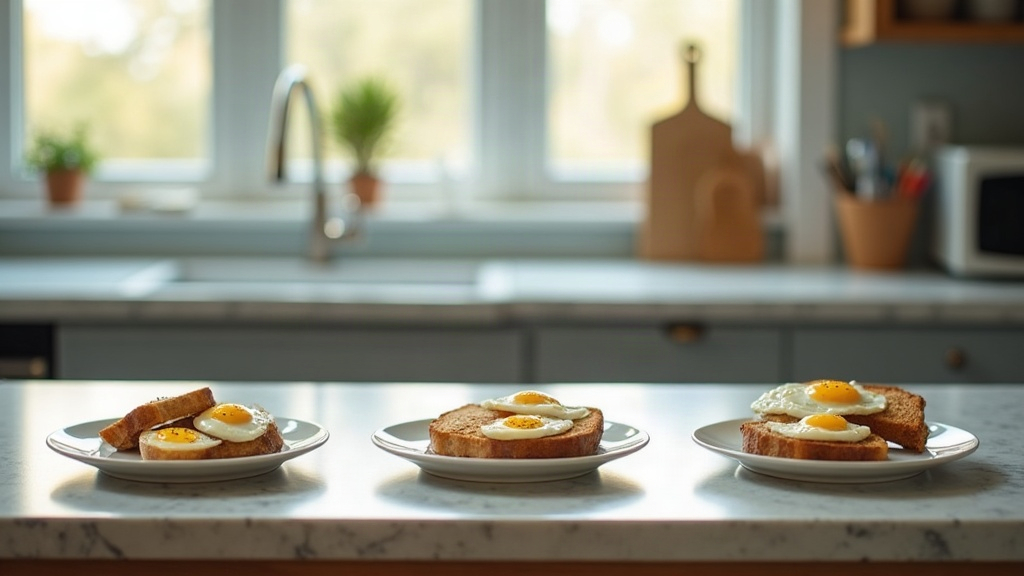
When you log a meal, the calorie total you see depends entirely on how you measured it. A kitchen scale, a photo, or your eye will each give you a different number, sometimes by more than a hundred calories. This piece compares three real-world logging methods against lab analysis to show where each breaks down, why it happens, and what level of accuracy actually matters for your goals.
Research conducted on 4 November 2026 evaluated weight scales, volume estimates, and AI photo recognition for the same meals. The findings indicate that there is no definitive "best" method; rather, they highlight the circumstances under which each method becomes less accurate and the level of error that can be tolerated while still achieving progress.
Quick answer: How methods compare in real conditions
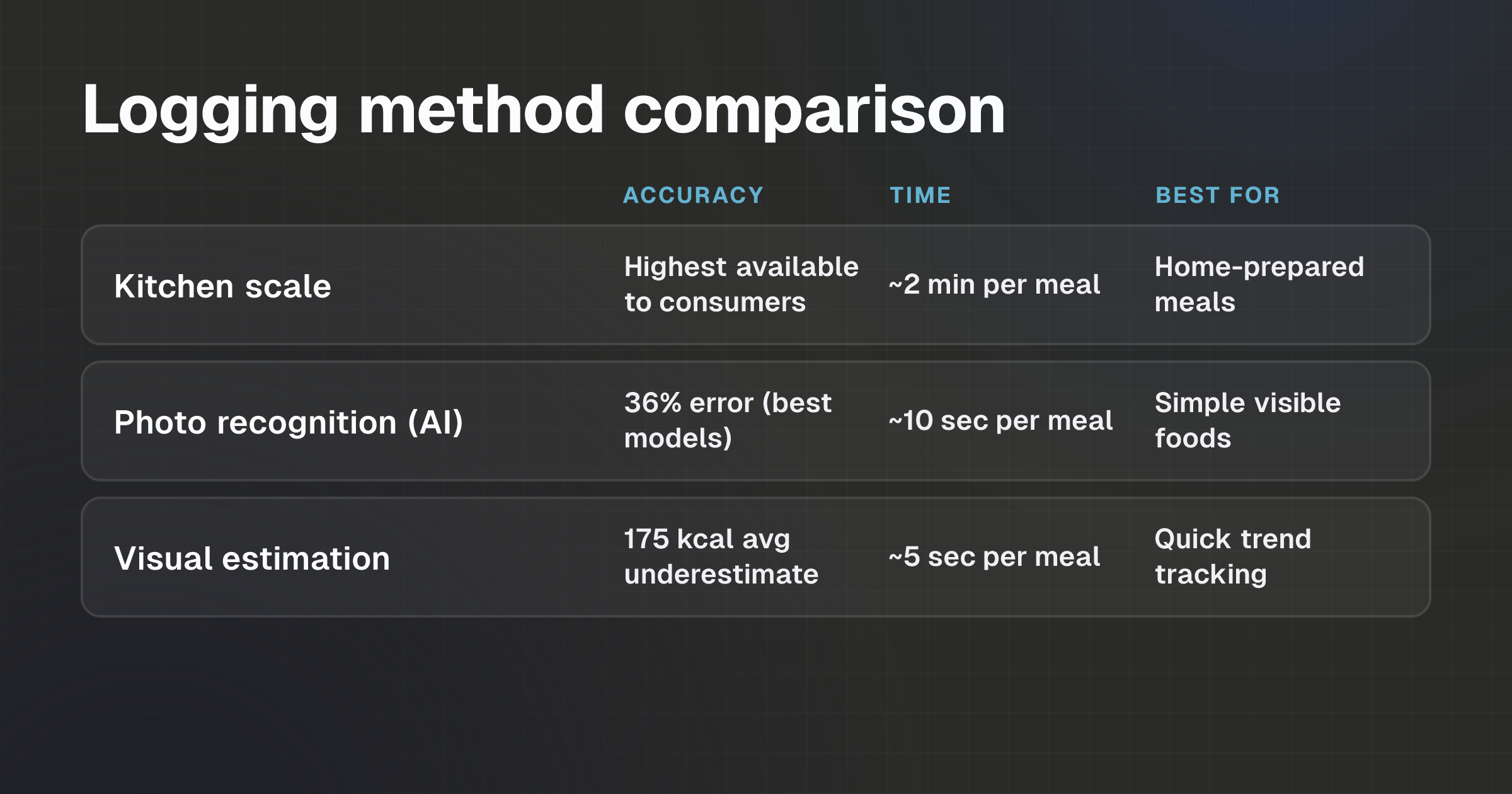
Weighing with a scale remains the most accurate method available to consumers, but requires time and a kitchen scale for each ingredient. Photo recognition (AI identifying foods from images) misses by roughly 36% on energy for the best-performing models, and can drop much further. Visual estimation (eyeballing portions) underestimates restaurant meals by an average of 175 calories per meal, and significantly more for meals perceived as healthy.
None of these methods is perfect.
The choice depends on whether you prioritize speed, precision, or the fit between effort and the accuracy you actually need.
What you need first: Choosing a method that matches your routine
Before selecting a logging approach, clarify three things:
-
Where you typically eat. Restaurant meals are harder to estimate than packaged foods or meals you prepare. Meals framed as healthy introduce additional underestimation bias, research shows people underestimate meals perceived as healthy by 20% in adults (and 25% in adolescents) compared to clearly indulgent meals of the same actual size.
-
How much time you have. Weighing everything takes longer but captures more detail. Visual estimation is faster but less precise. Photo recognition falls between them but introduces different errors.
-
What tools you have access to. A kitchen scale is inexpensive but not always with you. A smartphone is always with you but limited by what a camera can see. Fuel8's database, barcode scanner, and voice input offer fast logging without requiring manual portion entry for many common foods.
The research in this piece uses three logging methods as proxies for the accuracy trade-off: weighing (highest precision, highest friction), photo recognition (medium precision, medium friction), and eye estimation (lowest precision, lowest friction).
Step-by-step: Testing accuracy across methods
Step 1: Understand the baseline, lab analysis
Laboratory analysis is the reference point for all three methods.
When researchers in peer-reviewed studies compare logging accuracy, they measure the actual food using calorimetry or chemical analysis, then compare what each method predicted.
Step 2: Weighing with a scale
How it works: Use a kitchen scale to measure each ingredient before cooking or serving.
Accuracy findings: Weighing is generally considered the most accurate method available to consumers. It directly measures the food you eat rather than estimating it.
Where it breaks down: Weighing doesn't automatically account for hidden cooking fats. If you fry an egg in butter but only weigh the egg itself, you've missed the calories from the butter. Weighing requires attention to every ingredient and is impractical away from home.
Step 3: Photo recognition with AI
How it works: Take a photograph of your meal. An AI system (such as ChatGPT-4o, Claude, or Gemini) identifies the foods present and estimates quantities from the image.
Accuracy findings: Research by Fridolfsson and colleagues photographed 52 standardized items and meals in three portion sizes, then compared AI estimates against direct weighing. ChatGPT-4o and Claude 3.5 Sonnet achieved a mean absolute percentage error of about 36% for energy. Gemini 1.5 Pro ranged from 64% to 110%. A second study across 1,463 US meal photographs found the best-performing model missed by an average of 117 kcal per meal.
Where it breaks down: Photo recognition can correctly identify foods but cannot see:
- The exact number of items (how many eggs are in the bowl?).
- Internal composition (are those egg whites, whole eggs, or yolks?).
- Weight and density differences (different types of bread have different calorie densities).
- Hidden oils and cooking fats applied to the food.
The incomplete-information risk: Adding partial information can worsen the estimate. In one self-experiment, an initial photo estimate of 600 kcal was 17% high (actual: 514 kcal). When told the eggs were "mainly whites," the estimate dropped to 425 kcal, making it 17% too low. More information led to a confidently different but less accurate answer, not a better one.
Step 4: Volume estimation (eyeballing portions)
How it works: Estimate portion sizes by sight, using hand size, common objects, or mental reference points, without measuring tools.
Accuracy findings: Research measuring actual restaurant meals shows people underestimate them by an average of 175 calories per meal. The underestimation grows larger as meals get bigger. Meals perceived as healthy introduce a "health halo" effect: adults underestimate these meals by 20% compared to clearly indulgent meals of the same actual size.
Where it breaks down: Visual estimation is highly subjective and prone to significant error, especially with:
- Complex dishes where multiple ingredients are mixed.
- Restaurant meals where portion size is inconsistent.
- Meals labeled or perceived as healthy, which people consistently underestimate more than indulgent meals.
Step 5: Decide what accuracy level you need
Perfect accuracy is rarely necessary or achievable.
If your goal is to understand trends over weeks, a rough daily log is often enough. If your goal is precise macro targets, you need more precision. Weigh daily. Believe the weekly average. accounts for day-to-day variation while tracking a more reliable pattern.
Ask yourself:
- Am I tracking to understand my typical intake, or to hit a specific daily target?
- How much error would change my decision?
- Is consistent logging more valuable than perfect logging?
Example or scenario: Logging breakfast at home versus lunch out
Scenario 1: Breakfast you prepare at home.
You cook two eggs in butter, add toast, and a cup of coffee with milk.
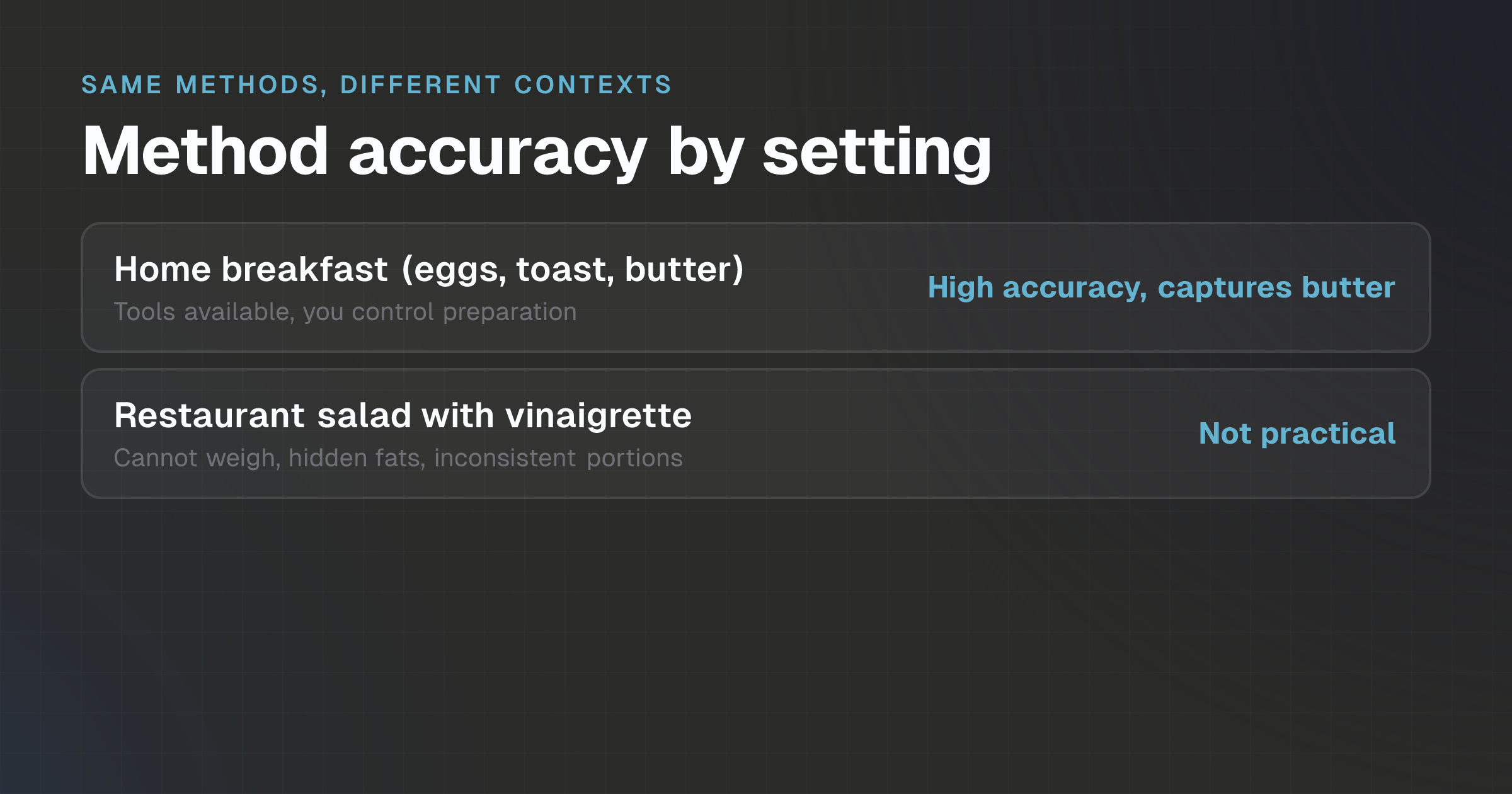
- Using a scale: Weigh the eggs (100g), the butter added to the pan (10g), the bread (40g), and the milk (40ml). Total time: 2 minutes. Accuracy: high. This method captures hidden cooking fat.
- Using photo recognition: Photograph the finished plate. AI identifies two eggs, toast, and coffee. It may guess the eggs are whole and the butter amount is typical. Estimate: ~500 kcal. If one egg was actually a white and the butter was less, the real total could be 380 kcal. Accuracy: moderate to low. Time: 10 seconds.
- Using eye estimation: Eggs look "medium" (roughly 70-80 kcal each), toast is one slice (~80 kcal), coffee with milk (~20 kcal). Estimate: ~250 kcal. But you didn't measure the butter, so you've missed ~90 kcal. Real total: ~340 kcal. Accuracy: low. Time: 5 seconds.
At home, weighing is practical because your tools are available. The scale catches the hidden butter.
Scenario 2: Lunch at a restaurant.
You order a salad labeled "grilled chicken, mixed greens, vinaigrette" (~450 kcal on the menu).
- Using a scale: Not practical. You don't have a scale, and the restaurant won't let you disassemble and weigh the meal.
- Using photo recognition: Photograph the salad as served. AI identifies chicken, greens, and dressing but cannot see how much oil is in the vinaigrette or how much chicken is actually there. Estimate: ~420 kcal. The restaurant's preparation might include 3 tablespoons of oil (270 kcal) instead of the 1 tablespoon implied by "vinaigrette." Real total: ~650 kcal. The photo estimate was 35% low. Accuracy: low. Time: 10 seconds.
- Using eye estimation: The salad looks "healthy," so you estimate the menu's stated 450 kcal as correct, or maybe adjust slightly. Research shows healthy-labeled meals are underestimated by 20%, so you might estimate 450 kcal when the real total is closer to 600 kcal. Accuracy: low. Time: 5 seconds.
Out of home, all three methods lose accuracy because you cannot control the preparation or measure it fully.
Photo recognition and eye estimation are similarly inaccurate in this context. Weighing is impossible.
For restaurant meals, Barcode Scanning vs. Voice: Which Logs Macros Faster? and database searches (like Fuel8's 13,521-food database) offer a middle ground: you log the restaurant's name and dish name, and the app provides an average estimate based on similar meals. This is less accurate than home-prepared meals but faster than trying to estimate every component.
Common mistakes: What reduces accuracy without you realizing it
Mistake 1: Assuming photo recognition is "good enough" for all meals.
Photo recognition works reasonably well for simple, visible items (a sandwich, a piece of fruit). It fails for mixed dishes, sauces with hidden fat, or meals where internal composition matters. In the self-experiment cited above, adding incomplete information made the estimate worse, not better.
Mistake 2: Trusting menu calorie counts for restaurant meals.
Menu estimates often omit cooking oils, use smaller portions than what's actually served, or undercount dressings.
Research shows people underestimate restaurant meals by an average of 175 calories per meal. The menu number is a starting point, not a guarantee.
Mistake 3: Underestimating "healthy" meals.
Meals labeled or perceived as healthy are underestimated by 20% in adults and 25% in adolescents compared to indulgent meals of the same actual size. A salad at a health-focused restaurant is not lower-calorie just because it's called healthy; it may contain more oil or cheese than a simple description suggests.
Mistake 4: Only weighing some ingredients.
If you weigh the chicken but eyeball the oil, you've sacrificed the benefit of the scale.
Weighing is most useful when you measure the hidden components (oils, dressings, condiments) that are easy to underestimate.
Mistake 5: Logging differently on different days.
Switching between methods day to day makes it harder to spot trends. If Monday uses a scale, Tuesday uses photos, and Wednesday uses estimates, the variation in logging method obscures the variation in actual intake. Pick one method and stick with it for at least a week so the data is consistent.
FAQs
Should I use photo recognition or a food database for restaurant meals?
Photo recognition is fast but makes errors on hidden ingredients and portion size. Food databases (like Fuel8's 13,521-food database) rely on crowd-sourced or standard recipes, which may not match your specific restaurant's preparation. Photo recognition is worth trying if you want speed; a database search may be more reliable if you return to the same restaurants frequently and can verify the estimate against your plate.
How much does the health-halo effect matter in practice?
Research shows adults underestimate healthy-labeled meals by 20% compared to indulgent meals of the same actual size. Over a week, if you log three "healthy" restaurant meals at 400 kcal each when they're actually 480 kcal each, you've missed 240 kcal of cumulative error. For weekly trend-tracking, this matters; for a single meal, it may not shift your decision.
Can I mix methods, weigh some meals and estimate others?
Yes, but be consistent about which meals you weigh.
Weighing home-prepared meals where you control the ingredients and have tools available is practical. Estimating restaurant meals is necessary because you cannot weigh them. The inconsistency doesn't harm your progress as long as you're aware of where each method loses accuracy. How to Measure Food Portions for Calorie Tracking covers this in more detail.
How much error is "acceptable" when tracking?
This depends on your goal. If you're tracking to understand whether your typical intake is 2,000 or 2,500 kcal per day, a margin of ±100 kcal per meal is acceptable. If you're targeting a specific macro ratio or a narrow calorie range, you need more precision. Research on calorie restriction shows adaptive thermogenesis (metabolic slowdown) occurs when energy intake drops significantly below your baseline; small daily errors don't usually trigger this response, but consistent underestimation over weeks might change the interpretation of your results.
Does rough logging lose value compared to precise logging?
No. A rough daily log is more useful than no log.
Consistency matters more than precision for tracking trends. Stupid Simple Macro Tracker: Stop Overthinking explores why logging roughly beats not logging at all, even if the numbers aren't perfect.
What happens if I log one method at home and a different method when I eat out?
You'll get useful data as long as you recognize the difference in accuracy between contexts.
Home-logged meals (especially weighed ones) will be more precise. Restaurant meals (logged via photos or estimates) will have larger error margins. Over weeks, the trend is still visible even though individual meal accuracy varies. The key is logging consistently within each context so patterns emerge.
- Macro Tracking Techniques
- calorie logging accuracy
- food scale accuracy
- photo food logging
- visual portion estimation
Fuel8 is on the App Store.
A food diary for iPhone. It tracks protein, carbs and fat alongside calories, shows a weight trend rather than a daily verdict, never adds exercise calories back, and has no streaks to break.
Download on the App StoreGet the seven-day Fuel8 email guide, including how the app works and membership benefits. Then occasional recipes and product updates.
Your name and email go to Grow More Services L.L.C-FZ, the company that builds Fuel8, and are stored in Resend so we can email you the seven-day app guide, membership benefits, recipes and product updates. An account is not required. Unsubscribe in one click, any time.
This piece is editorial content and not medical or dietary advice. The full health disclaimer is below.